Todd Wainio
World War ZTodd Wainio is one of World War Z’s defining survivor-witnesses: a former U.S. Army infantryman whose memories connect the panic of the first American defeats to the disciplined campaign that eventually reclaimed the continent. His decisive significance lies in the contrast between the public image of victory and the private condition of the veteran who helped make it possible. The famous mural behind him turns his memory into a national icon, yet Todd remains physically diminished, emotionally shaken, and uncertain how to inhabit peace after years in which fear, killing, and waiting to die became normal.
Identity and Introduction
Todd is introduced in Denver, Colorado, where he waits at a train station beneath a mural called Victory. The image shows soldiers standing on the New Jersey side of the Hudson River with their backs turned toward the viewer as dawn breaks over Manhattan. Todd appears small and frail beside those towering two-dimensional figures. He has an expanding paunch, receding and graying hair, and three deep parallel scars running down the side of his right cheek. Although he is still young in strictly chronological terms, his body makes him look old before his time, marking him as a survivor whose biography has been compressed by war.
The interview setting establishes the distance between Todd as a person and Todd as a historical symbol. He is not presented first through medals, rank, or official distinction, but through a handshake, a station mural, and the visible evidence of injury. The national image promises dawn and collective renewal; the man beside it carries the cost that the image cannot show. This tension governs his entire testimony.
Yonkers and the First Defeat
Todd’s account of the Battle of Yonkers begins beneath a sky turned red by the smoke and pollution that had filled the air throughout the summer. He remembers seeing Yonkers, a depressed rust-belt suburb north of New York City, through an amber haze. The battle had already acquired the status of a national catastrophe, though Todd struggles to classify it. It was not quite a surprise attack, because the emergency had been underway for roughly three months, but it resembled a disastrous historical stand in which those in command should have understood what was coming.
He places the battle against the Great Panic, when civilians boarded up homes, stole food and weapons, shot at anything that moved, and generated further deaths through fires, traffic accidents, and uncontrolled violence. Todd’s judgment is that the panic may initially have killed more people than the infected. His observation makes the outbreak a crisis of social behavior as well as a biological or military emergency: fear turned civilians into hazards, while improvised violence multiplied the disaster before the Army had even established an effective response.
Todd understands why the authorities chose Yonkers. They needed one conspicuous stand to prove that the government still controlled events, calm the population, and create a propaganda victory while dealing with the real threat. He was sent into that demonstration. The location itself was defensible: part of Yonkers lay in a valley, the Hudson River stood beyond the western hills, and the Saw Mill River Parkway cut through the main defensive line. Unfortunately, refugees moving down the freeway were also leading the dead toward the troops. The terrain formed a natural choke point, and Todd considers the plan sound in principle—the only good idea of that day—before the battle exposed the gap between a good position and an unprepared force.
The engagement teaches Todd and his comrades that bodily destruction is not the same as incapacitation. The first barrage of “steel rain” tore infected bodies apart, scattering organs and flesh, but it did not reliably destroy the brain. Some of the dead continued walking; others, too damaged to stand, crawled forward. The second barrage was less effective because there were no remaining gas tanks to ignite and the more tightly packed dead shielded one another from head wounds. Todd’s recollection strips away the media’s familiar picture of dead people in business suits and dresses. Many of the early infected had died in hospitals or at home and approached in hospital gowns, pajamas, nightshirts, sweat clothes, underwear, or nothing at all, their wounds and dried marks visible on their bodies. The detail turns the enemy from an abstract mass into a record of ordinary deaths grotesquely continuing.
From Mechanized Army to Endurance War
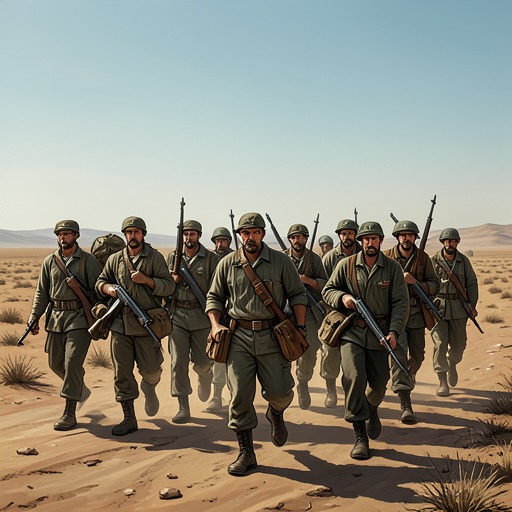
Todd’s later recollections describe an Army remade by the lessons of Yonkers. The new force was no longer mechanized in the old sense: tanks, artillery, and Bradley vehicles remained in reserve for the eventual recapture of cities, while Humvees and a small number of M-7 ASVs mainly carried ammunition and supplies. The soldiers marched on foot in columns, an image that recalled Civil War paintings. The Army’s language and appearance changed as well. Soldiers spoke of “the Blue” and “the Gray,” partly because of the dead’s skin color and partly because of the navy-blue uniforms that replaced camouflage.
The new battle dress was a light, comfortable coverall interwoven with Kevlar or similar bite-proof threads. It could be fitted with gloves and a hood covering the entire face, an option that later saved many lives during urban hand-to-hand fighting. Todd’s description shows how military technology shifted away from the spectacle of heavy equipment and toward the narrow practical problem of surviving physical contact. Protection against bites, ammunition carriage, marching discipline, and the destruction of the brain mattered more than the machinery that had failed at Yonkers.
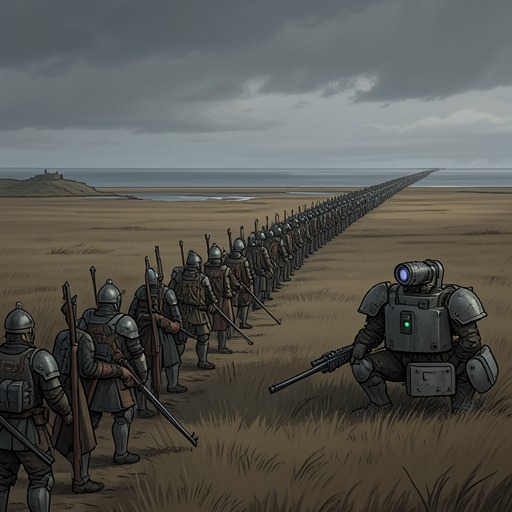
He also explains why the reconquest took so long. The American advance proceeded through three Army Groups—North, Center, and South—moving together across the Great Plains and Midwest before dividing at the Appalachians. The northern and southern wings aimed for Maine and Florida, while Army Group Center crossed the mountains and linked with them along the coast. The operation took three years. Its slowness was not a sign of weakness alone but an adaptation to an enemy that never tired, negotiated, surrendered, or reached an emotional breaking point. Todd’s experience therefore belongs to a war in which ordinary human assumptions about endurance no longer applied.
Scars, Family, and the Work of Memory
Todd’s personal life after the war is domestic but not uncomplicated. In Denver, he shares a home with his wife, Allison, and their son, Addison. The interview observes him downstairs in the kitchen washing dishes while Allison helps Addison with homework. Later, the family attends a neighborhood picnic in Victory Park, where Todd stands in the outfield waiting for a high fly ball he insists will never come. The scenes place him inside a restored community, yet the ordinary rituals are framed by the absence of reported sightings and by the continuing presence of the war in public memory.
His habits reveal a survivor managing pressure through repetition and controlled physical action. During the Yonkers recollection, he reaches for homegrown “Q” cigarettes, each containing only one-quarter tobacco, and finishes one in a single angry drag before immediately lighting another. At the end of the interview, he savors the 100-percent-tobacco Cuban cigarettes given to him as a parting gift. The contrast between the rationed domestic cigarette and the rare luxury of the Cuban tobacco makes the objects into small markers of wartime scarcity, postwar indulgence, and the narrator’s continuing need for something tangible to hold onto.
Todd admits that he sometimes loses control for minutes or even an hour. Doctor Chandra, who counsels him at the VA, has told him that these episodes are healthy “minor tremors,” like pressure released from a fault. The metaphor does not erase the trauma; it gives the trauma a livable explanation. Todd’s reaction is not portrayed as a clean cure or a return to prewar normality. Instead, recovery means learning to recognize the aftershocks and allowing them to pass without mistaking them for total collapse.
Victory and Narrative Significance
Todd’s most vivid memory has become the national icon represented by the station mural. He recalls standing on the New Jersey riverbank with other soldiers after receiving the news that it was VA Day, watching dawn over New York. There was no cheering and no celebration. Peace felt unreal because he had been afraid, fighting, killing, and waiting to die for so long that he had accepted those conditions as normal for the rest of his life. Even in retrospect, the sunrise sometimes feels like a dream.
That memory gives Todd’s testimony its deepest force. The mural presents the scene as a stable image of triumph, but Todd remembers uncertainty, emotional exhaustion, and the inability to understand what peace meant. The public image freezes a collective victory into a reassuring composition; his account restores duration, doubt, and bodily cost. He is both participant and reluctant monument, a man whose scars authenticate the picture while his unease challenges its simplicity.
Todd’s final gesture is directed not toward military glory but toward his mother: “I love you, Mom.” The statement closes his recollection by returning the enormous history of the Z world war to a private bond. His importance lies precisely in that movement between scales. He can explain the Great Panic, the failure at Yonkers, the reorganization of the Army, and the three-year road to New York, yet the emotional endpoint is not a doctrine or a battlefield. It is the voice of a survivor reaching back toward family after history has made him into an emblem.